How to Travel Cheap: 40+ Effective Budget Travel Tips

🔗 This post contains affiliate links, meaning I may earn a small commission if you purchase anything mentioned, at no extra cost. Thank you! See my Terms & Conditions for more info.
Do you want to travel the world, but don’t have loads of money to spend on a trip?
I’m with you on that one, friend!
Traveling seems really expensive these days. Like, really expensive. Even things like train rides have drastically gone up in price. And hotels that were once affordable are now considered mid-range properties.
Traveling is very much a privilege from many perspectives, but the financial logistics are of major concern. At first glance, it feels the more money you have, the better experiences you can have.
But that, friend, is where you’re wrong.
You see, just because you’re traveling with a budget, that does not AT ALL mean mean you’re broke. Traveling on a budget simply means being a bit more conscious of your spending than a luxury traveler.
In this post, I’m going to share 48 of my favorite budget travel tips. These are useful if you’re a PTO traveler, a broke college student, or simply someone who wants to be smarter with their money. Because no matter how much or little money you have, you deserve to see the world. It’s way too nice out there for you to miss out!
Ready, friend? Let’s go!
THIS POST IS ALL ABOUT HOW TO TRAVEL CHEAP.
WHAT DOES IT MEAN TO TRAVEL CHEAP?
There’s this negative idea that traveling cheap means settling for hotels in unsafe areas, flying ultra low-cost airlines, skipping all the tourist attractions, packing only a personal item, and cooking every single meal. But I’m here to tell you that traveling cheap doesn’t have to involve any of that.
To travel cheap simply means to be smart with your spending.
And yes, it involves a little something called a budget. But the sooner you realize that a budget is just a plan for your money, the sooner you can travel cheap and have the time of your life. PLEASE ingrain this in your head immediately, friend!
That’s out the way now. Let’s get into these budget travel tips. I hope you can pick up a few and implement them into your next solo trip.
HOW TO TRAVEL CHEAP
BUDGET TRAVEL TIPS FOR ACCOMMODATIONS
No matter where you stay, whether a nice 4-star Hyatt property or an ancient 3-star Garden Inn hotel, your hotel is almost ALWAYS going to be the most expensive part of your trip.
That said, I’m going all in on this category. Continue reading for some of my best tips for saving money on hotels without staying at those old, outdated properties. Because the hotel is half the fun, is it not?
STAY WITH FRIENDS OR FAMILY
I did this a lot when I first started traveling, and it was an excellent way to save money on my trips. You can easily save at least $600+ doing this, which gives you tons more money to spend on food, shopping, or activities.
KNOW WHEN TO BOOK FOR THE BEST RATES
There’s this really annoying thing called dynamic pricing. I’m also going to mention a bit later because it applies to a lot more than just hotels, but let’s focus on those for now.
With dynamic pricing, the rate of a hotel can change drastically during the weeks leading to check-in. Three months prior, you might be looking at $225 per night. But then one month before, prices might skyrocket to $450 a night. And then go down to $200 just a few weeks before. Crazy, innit?
Similar to flights, there’s no such thing as the “best time” to book a hotel. As soon as you have the money, that’s when I’d say you should go ahead and book your accommodations. In case the rate goes down, make sure you book a refundable fare.
TRACK ROOM RATES AFTER BOOKING
You might be shocked to hear this, but hotel prices can change AFTER you book your room. You could save $100 or more just by staying on top of these price changes.
It can get exhausting checking prices every day, so I recommend using a service like Google Hotels or Hotels.com for automatic price drop notifications.
COMPARE DIFFERENT HOTELS
This tip is fairly obvious but, I mean, hey, it works!
You’ll typically want to stick to one hotel so you can accumulate points over time. But if you’re seriously trying to save money, don’t hesitate to search the market. There are tons of hotels out there, especially in the ultra-touristy cities like New York and Los Angeles.
CONSIDER STAYING IN A SHORT-TERM RENTAL
If you’ve checked out any of my other hotel posts, you’ll know that my number-one accommodation recommendation for solo travelers is hotels. They’re safer, more central and often serve free breakfast.
But if you’re under 21 or wouldn’t mind staying a bit further from the touristy areas, I think a short-term rental like Airbnb or VRBO could be a solid choice. Just exercise extra caution for your safety and know what steps to take before booking your reservation.
STAY IN HOSTELS
Hostels sometimes get a bad rep because you have to share a space with utter strangers and can’t protect your belongings like you would in a regular hotel.
Buuuuuut, if funds are looking a bit low or you don’t feel like shelling out $300+ for a hotel, you should opt for a hostel.
Remember: not all hostels are created equally. Many of them actually have private rooms that are still cheaper than traditional hotels. And of course, if you’re open to the idea of staying with other travelers, that’s fine, too.
LOOK INTO COUCHSURFING
Couchsurfing is when people allow you to sleep on their couch or spare bedroom for free (or a MUCH lower cost than a hotel). Of course you have to practice discernment and do tons of research when doing this, but I think it could be a decent way to save money on accommodations when traveling.
DO SOME HOTEL-HOPPING
Logistically speaking, I know hotel-hopping can be a bit stressful. Especially for shorter trips. And I usually wouldn’t suggest you do it.
But if you’re traveling for a longer period of time and are open to staying in multiple hotels, this could be a good idea. You could create a good balance of budget-friendly and luxury-adjacent properties.
BUDGET TRAVEL TIPS FOR FLIGHTS & AIRPORTS
Flights are often one of the most expensive categories for traveling. Continue reading for some of my tips for saving money on flights without flying on any ultra-budget airlines like Frontier.
TRAVEL CARRY-ON ONLY
If you’re used to checking a large suitcase for every single trip, regardless of duration, you’re probably rolling your eyes at this.
And frankly, 16-year-old me probably would’ve done the same.
What do you mean I have to pack all my stuff in a small carry-on bag? Where are all of my full-sized skincare products supposed to go?
Ever since I started traveling more (and, frankly, paying for my own trips), I’ve been increasingly aware of and attentive to every trip-related expense, including baggage fees. Not having to pay for my bag was, as you’d expect, pretty enticing.
Ever since, I’ve been traveling carry-on only. I don’t even THINK about checking a bag unless I’m going on a vacation (because there IS a difference from a trip) which is usually longer and more relaxed.
KNOW THE “BEST” TIME TO BOOK FLIGHTS
Let me backtrack for a second. There really isn’t a widely agreed-upon “best” time to book your flights. Because prices fluctuate with a rather annoying number of variables, so you never really for SURE the best time.
BUT if you’re within the 1-3 month window and consider various things like season, time of year and special events, you should be able to score a reasonably priced flight.
I’m considering writing a dedicated post all about my strategy for booking affordable flights, so let me know if you’re interested in that!
GET A JOB AT THE AIRPORT OR PURSUE A CAREER IN AVIATION
As you’d imagine, you get discounts on flights if you work at the airport or have a career in aviation. Sometimes you can even get free flights, which, hello, you can’t beat!
I’m not saying you need to do a complete career pivot, but if you’re open to it, I think this is a nice “hack” for saving money on flights.
GET DISCOUNTED FLIGHTS FROM AN AIRPORT EMPLOYEE
Alright, maybe an airport job isn’t really your thing. Cool.
Perhaps a friend or family member has some of those cool perks I just mentioned in the last tip. Reach out to them and see if you can snag a deal — or even fly standby.
Just don’t be needy and ask them too often. I’m sure that gets on their nerves after a while!
BRING YOUR OWN SNACKS
Airport food can be notoriously expensive. Like, $7 for a bottle of water? Really?
The good thing is that you can simply bring your own snacks from home or make a quick stop at a nearby gas station/convenience store on the way to the airport. It may seem small, but you’ll save a good amount of money doing this.
Please keep in mind that you can’t take any liquids over 3.4 ounces through TSA. The agents will throw your stuff away faster than the McAllisters ran through the airport in Home Alone.
That makes bringing drinks through TSA a bit difficult, but at least you’ll save money on your favorite snacks like pretzels or chips. Because even those can cost upwards of $10 which, again, is ABSURD to me.
BRING AN EMPTY WATER BOTTLE
While you can’t bring a full bottle of water through TSA due to the liquid requirement I just mentioned, you’re free to bring an empty water bottle and fill it after you pass security.
There’s usually tons of water fountains placed throughout the airport — and many of them have a specific area to fill your water bottle without having to awkwardly tilt it. You know what I’m talking about, right?
Sometimes the water doesn’t taste AMAZING, but it’s free. Beggars can’t be choosers, can they?
GO FOR THE CHEAPER AIRLINES
Carriers like Frontier and Southwest are able to offer cheaper flights since they don’t have as many destinations or amenities as the more expensive ones, such as Delta or United.
Please keep in mind, though, that it’s better to travel carry-on only with these cheaper airlines. They earn a decent amount from checked luggage, and the whole point in flying with them is to SAVE money!
KEEP YOUR OPTIONS OPEN
To piggyback off the previous tip, try to keep your options open when looking for flights.
If you’ve ever gone on Google Flights, you’ll see a nice variety of options for flight times, durations, airlines and, most importantly, prices. ****
Sure, you might be loyal to Delta, but what about that Southwest flight that’s $100 cheaper? Plus, Southwest is known to have some rather humorous and entertaining flight attendants!
DON’T BE LOYAL TO ONE AIRLINE
I wouldn’t have given this advice a few years ago. Back then, it actually benefited you to have status with a certain carrier.
But nowadays, almost every carrier has this painfully annoying model where there are multiple levels for economy.
I’m not sure if you’ve noticed this, but here’s an example in case you haven’t:
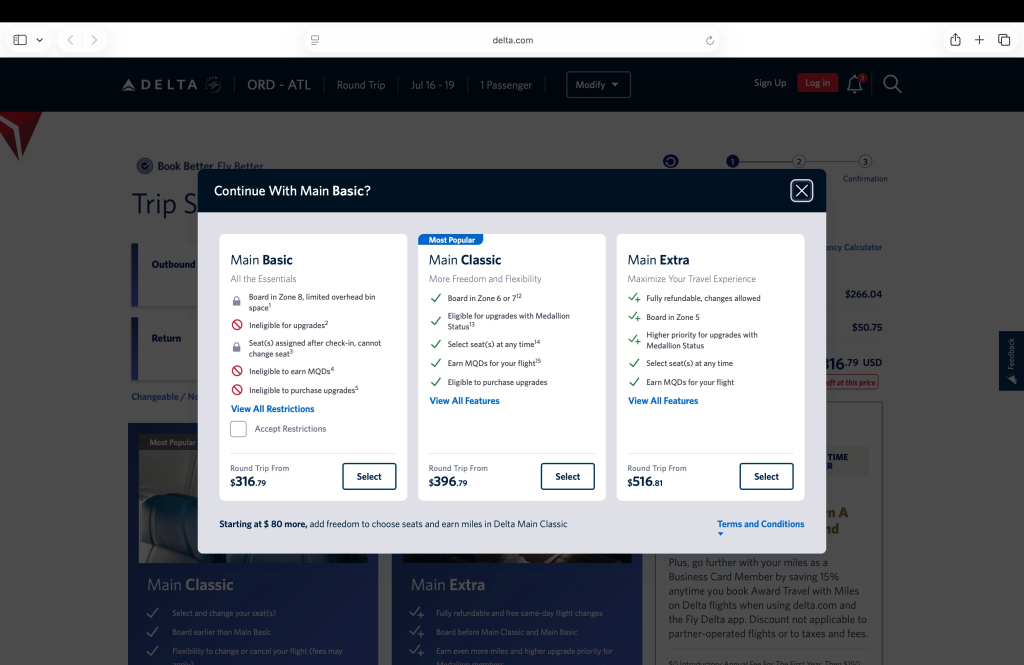
As you can see, there are a NUMBER of restrictions on the cheapest ticket. It’s set up to where you practically have no choice but to spend at least an extra $80 just to get some decent “perks” (which, in reality, are just standard things you would‘ve gotten for free a few years back).
So at this point, I think it’s much more feasible to go with the cheapest option. Even if you prefer to fly with Delta, you might have to fly with Southwest or American to save money.
BUDGET TRAVEL TIPS FOR ACTIVITIES
The prices for activities are typically tame, but when you add them up, they can get a bit hefty. Continue reading for some of my tips for saving money on activities without skipping anything you really want to do.
BUY ATTRACTION PASSES
I absolutely LOVE attraction passes! They’re a smart option if you’re already planning on visit most of the attractions. Even if you’re still in the research phase of planning a trip, these attraction passes can really come in handy.
The main benefit of these is that you get a discount on the attractions with them being grouped. Just make sure you see what you actually want to do and determine whether it’s cheaper to book things individually or to buy an attraction pass.
I have a tool for this in my TSS Freebie Library. Click here to check it out the next time you need help deciding!
BOOK THINGS IN ADVANCE
Just like with hotels and flights, the prices of activities can fluctuate.
I know, I know… it’s annoying. But the solution is fairly easy: book things in advance! Not only does this save you money, but it’s also nice to get that step out the way and have a peace of mind knowing everything’s booked.
Oh, and not to mention, many attractions sell out nowadays, so it’s crucial that you book them ahead of time.
STICK TO THE ABSOLUTE MUST-DO’S
Look, I know there’s about a million museums to choose from in New York City and Washington DC. The number of options is actually paralyzing. You look at them and want to experience it all!
But if you’re trying to save money or want a less chaotic visit, stick to the absolute must-do’s. These are the things that you’d be sad about if you skipped them.
This could be a museum like the Museum of Fine Arts in Boston, a landmark like The Arch in Saint Louis, or an architecture river cruise in Chicago.
TAKE ADVANTAGE OF FREE MUSEUM DAYS
Many of the top museums like The Met Museum in NYC and the Art Institute of Chicago have these things called “free museum days” — which are, well, exactly what they sound like.
Here’s the thing, though: a lot of them are reserved for residents, college students, or elderly people. But it’s still totally worth checking them out because you can save a good amount of money if you’re able to visit on one of these free museum days.
Be sure to research this stuff in advance so you can make your itinerary accordingly! You don’t want to be there and miss the free museum day by one day and have to pay $50.
TRY FREE ACTIVITIES & TOURS
Hear me out: just because it’s free, that doesn’t automatically mean it’s bad or boring. If anything, some free activities like the Smithsonian museums in DC and free walking tours in NYC are very much worth your time.
There are various resources for finding free activities to try. Travel blogs, YouTube, Reddit and local residents are some of my favorites.
Simply search “free things to do in [destination]” and you’ll find a surprising number of free activities! Be sure to do some quick research to determine whether it’s something you’re actually interested in.
Because at the end of the day, you only have so much time during your trip, and you’ll want to make good use of it.
BUDGET TRAVEL TIPS FOR TRANSPORTATION
WALK WHENEVER YOU CAN
You already know this if you’re a frequent reader of The Solo Solstice. But in case you don’t, we love to walk! I sometimes don’t even bother documenting a trip if the city wasn’t walkable enough. Yeah, it’s that serious.
Walking is, financially speaking, the BEST way to get around when traveling. Not only do you save money, but you also get some good physical activity in and explore the city in arguably the best way possible.
Above all else, you should consider walking compared to any other mode of transportation.
TAKE PUBLIC TRANSPORTATION
I know I just went on a rant about how great it is to walk when traveling. And while I stand on that, I do understand that walking isn’t always the best option.
Sometimes you need to go a bit farther or simply don’t feel like walking. In those moments, you should take advantage of the city’s public transportation. Unfortunately, not many American cities have great transportation.
In fact, only 5 cities are considered truly walkable in the US: New York, Boston, Philadelphia, Seattle, San Francisco, and Chicago. And yes, the trend you’re likely picking up on is accurate: most walkable cities in America are on the east coast.
Don’t worry though — EVERY destination I write about is walkable and/or has a decent public transit network.
BUY A MULTI-DAY PUBLIC TRANSIT PASS
If you’re going to be in the city for a few days, consider getting a multi-day public transit pass.
Just about every city with good public transportation has these, so you shouldn’t have any trouble getting one. This usually ends up being a bit cheaper than paying for each individual ride. You also usually get discounted rates on train or bus transfers, which is a nice perk.
Do the math to estimate and decide whether it’d make more sense to get a pass or pay for individual rides. Because sometimes it actually DOES make more sense to pay each time.
I’m creating a tool for this, so stay on the lookout. It’ll be in my TSS Freebie Library when it’s available to download.
COMPARE PRICES BEFORE ORDERING AN UBER OR LYFT
Uber and Lyft are direct competitors, and that couldn’t apply any more to their pricing. I’ve found that Lyft almost always costs slightly less than Uber. I don’t exactly know why, but it’s something I’ve observed on the last few trips I’ve taken.
JOIN A RIDESHARE LOYALTY PROGRAM
Just like with an airline or hotel loyalty program, I suggest joining a rideshare loyalty program. You get some great perks — including discounted rates and points — from being, well, loyal to the company!
It’s a bit difficult to decide which one is best, considering the rates usually fluctuate. I personally have Uber One because I get discounted rides along with discounts on food. It’s basically a win-win situation and I love it!
AVOID PEAK HOURS WHEN USING RIDESHARE
During these hours (4-6PM), prices increase quite a bit, and you don’t want to spend an extra $10 on an Uber just because it’s rush hour. In these instances, it’s better to take the train or bus if possible.
STAY SOMEWHERE CENTRAL
Staying central is secretly one of the BEST ways to save money while traveling. In fact, in my itineraries, I always choose a central location to base yourself.
By staying central — as in, picking an accommodation that’s close to all the activities you’re doing — you spend less money and time getting to the places on your itinerary (museums, attractions, parks, shopping centers, train stations, restaurants, etc).
For example, if you’re only a 10-minute train ride from these places, you’d probably only spend $5 getting there and back, compared to $20 for an Uber or Lyft. It’s pretty easy to do this: plan the activities you want to do and the restaurants you want to try.
Group them by neighborhood or area, then use Google Maps to find the nearest hotels. I go into more detail about this in my itinerary-planning guide, so check that out when the post goes live.
BUDGET TRAVEL TIPS FOR FOOD
COOK MOST OF YOUR MEALS
If you’re one of those people who says, “There’s no way I’m cooking on vacation,” I genuinely understand where you’re coming from…
But this tip isn’t for you.
Cooking your meals while traveling can save you a considerable amount of money. Especially if your trip is longer than, say, four days.
And it’s not like you’re limiting yourself to your own meals. You can still go out for one special meal every day, whether that’s breakfast, lunch, or dinner — and I actually encourage that, which brings me to my next tip…
SPLURGE ON ONE MEAL
Another great budget travel tip for food is to spend a good amount on one meal while saving on others.
Breakfast and lunch naturally tend to be a bit more budget-friendly — especially for casual spots and chains. If you really want to go all out, dinner is probably the most appropriate meal for that.
EAT AT LOCAL SPOTS
Many times the popular restaurants in an area are priced higher due to tourism. If you want to save money on food, I recommend eating at local spots.
Now, how the heck do you find those? There’s several ways, but I always like looking on Reddit and local travel blogs. You can even walk up to someone and ask them what their favorite local spots are.
Just make sure you find someone who looks both approachable and like a local. It’d be a little embarrassing if they happened to be on their first trip their too!
This is also a great way to do a little something many seasoned travelers like to call “living like a local.” I’m personally not at that point yet since I’ve got a lot of ground to cover, but it doesn’t hurt to sprinkle a little bit of locality into a trip.
TAKE ADVANTAGE OF LUNCH SPECIALS
Restaurants all over the world have lunch specials — and you should take advantage of them if you’re traveling on a budget.
You could very easily get an entree, side, and drink for around $20-30, which I think is a pretty good deal depending on where you’re going.
BOOK A HOTEL WITH FREE BREAKFAST
Right after flights and accommodations, food can be one of your biggest travel expenses.
Before you know it, you’re spending an average of $50 for each meal — and that can add up pretty fast. So instead of eating out for every meal, I suggest booking hotels that offer free breakfast. This is a great way to save money (and time) on money. Try to fill up on breakfast and have a light lunch, then go all out for dinner.
Oh, and if you combine this tip with cooking most of your meals, you can really save a good amount of money. At that point, you’re essentially only eating out once per day which, as you’d expect, can stop a hole from burning in your wallet.
ONLY EAT WHEN YOU’RE HUNGRY
For some odd reason, I have a much smaller appetite when traveling.
I don’t know if it’s the adrenaline or if I’m just trying to avoid bloating, but I don’t eat much during a trip. Usually 1-2 moderate meals are sufficient. So when you’re traveling, try to only eat when you’re hungry.
BUDGET TRAVEL TIPS FOR SOUVENIRS
GET SOUVENIRS FROM A CONVENIENCE STORE
Souvenirs can be quite pricey at souvenir shops and in airports. Sellers know tourists will pay a premium because, well, they want physical items to commemorate their trips.
But I’ve found that you can get some pretty nice keepsakes in convenience stores like 7-Eleven, CVS, Walgreens, Walmart, or Target. They’ll be just as nice, but a fraction of the cost.
ONLY GET WHAT YOU’LL ACTUALLY USE
It’s tempting to walk into a souvenir store and reach for EVERYTHING that looks nice.
But if you’re trying to stay within your budget, I would advise against this. While shopping for souvenirs, think whether you’ll actually use them. PLEASE don’t buy them for the sake of having them.
OPT FOR CHEAP SOUVENIRS
Some souvenirs like sweatshirts or local paintings can be costly, but those aren’t the only kinds of souvenirs out there.
There’s also tons of smaller, cheaper souvenirs that deserve to go home with you. These include postcards (my FAVORITE souvenirs), keychains, or even train tickets, museum passes, or receipts — in fact, those are my favorite to use in my travel scrapbook.
GENERAL BUDGET TRAVEL TIPS
USE DISCOUNT CODES
Usually you’ll find these in YouTube videos, blog posts and social media posts. Of course you likely won’t find anything like 50% off a first class flight (although that does sound nice), but you can typically find some good deals.
TRAVEL CLOSE TO WHERE YOU LIVE
Hear me out on this one. If you’re in dire need of a trip, but don’t have tons of money to blow, consider traveling within your home state.
If you’re fortunate enough to live on the east or west coasts, you’ve got some solid options.
On the east coast, you’ve got New York City, Boston, Philadelphia, Pittsburgh, Washington DC, and Baltimore. If I lived on the east coast, I’d probably spend months just traveling through the region.
And then you’ve got the west coast: California, Washington, Nevada, and Arizona. I listed the states here instead of specific cities because they all have numerous cities worth visiting.
Even if you don’t have any fun cities nearby, you can take a staycation, which is basically what I’m talking about in this section. A staycation is the kind of vacation where you stay in your hometown.
Let’s say you live in Minnesota. You can take a staycation by visiting the downtown area, staying at a nice hotel and act like a tourist in your own city.
I only live five hours from Chicago which, if you didn’t know, is my favorite city to travel. Since I live close, that allows me to visit a lot more often than if I lived farther away.
You end up saving a decent amount of money on transportation by doing this since you don’t have to pay for any flights (assuming you’re not flying anywhere, of course – take advantage of Amtrak!).
TRAVEL OUT OF THE COUNTRY
In the past, it was often cheaper to travel within the US. But prices have increased over the years and, at this point, you might be better off traveling overseas.
One big advantage of traveling overseas is that you can stay in hostels, which are basically these dorm-like hotels. You usually have to share your space with other people, but it can be a great way to connect with others and save money while doing so.
The US dollar also goes farther in countries like Czech Republic, Columbia, Mexico, Denmark, and Indonesia.
TRAVEL BASED ON COST, NOT DESTINATION
This is where Google Flights and Skyscanner come in handy. If you’re traveling on a budget or simply don’t know where you want to go, you can use either of these resources to find affordable destinations.
Essentially, you do a very broad search (from your hometown or nearby airport to anywhere in the US), put in some sample dates, and browse your options. You’ll be shocked to find where you can go with a budget in mind.
When looking through the results, be mindful that the prices shown are kind of deceiving. They’re often the lowest possible prices, which is obviously great for budget travelers, but if you look closely, you’ll see that those fares rarely offer free checked bags or seat selection.
So be sure to change your filters if you want a more realistic idea of what you’ll be spending on flights.
TRAVEL DURING THE SHOULDER SEASON
In case you’re unaware, there’s specific seasons when traveling. There’s the peak season, low season, and best of all, shoulder season.
The shoulder season — my favorite — is the perfect middle ground because the weather and prices aren’t crazy, but you’ll still have a pleasant time. This is especially nice for people who don’t like to travel amongst large crowds of other tourists.
CHOOSE BUDGET-FRIENDLY DESTINATIONS
This one’s pretty obvious.
The easiest, most logical way to travel cheaply is to visit budget-friendly destinations. Often these are less-touristy places, but if you hate crowds or prefer slow travel experiences, this could be perfect for you!
Here are some of my favorite budget-friendly destinations in the US:
- Chicago, IL
- New Orleans, LA
- Myrtle Beach, SC
- Savannah, GA
- Philadelphia, PA
- Washington, D.C.
GET A TRAVEL CREDIT CARD
Please take this with a grain of salt because I don’t want you to go and open a new credit card without doing THOROUGH research.
Having a travel credit card is an amazing way to earn points on flights, hotels, transportation, and food. If you build up your points enough, you can even get free flights!
Who doesn’t love free stuff?
You can also earn points indirectly toward travel through regular daily purchases like gas, groceries and entertainment. And don’t underestimate how quick they can add up — just go a month spending like you normally would, and see how many points you’re able to accrue!
I will say, some travel credit cards are better than others for a variety of reasons. The best travel credit card is the one that you can maximize the most. I’ll be writing a post on all things travel credit cards, so stay tuned for that.
Until then, I highly recommend the Chase Sapphire Preferred card. If there I only had ONE travel credit card, it’d be this one. The point multipliers are pretty good, it has good travel protections, and I love that it doubles as a daily spending card.
BE AS FLEXIBLE AS POSSIBLE
The more flexible you are, the more options you’ll have.
Plus, you’ll be far less stressed because you’re not limiting yourself to a specific destination, hotel, airline, or set of activities.
For example, say you’re planning a trip to Chicago. You want to visit in July and do all the touristy things the city has to offer. But you start pricing things and realize that July is a fairly expensive month to visit Chicago.
No problem!
Since you’re being flexible with your plans, you can simply search for different months to visit. Like May, for example. It’s only two months sooner than you initially planned, but prices are much more tolerable.
See how this works? As a budget traveler, being flexible is one of the best things you can do to save money on your travels.
TRAVEL DURING THE WEEK
Any time I’m looking at Google Flights, I notice that the weekday flights are often cheaper than the weekend ones — and it makes sense. Even though there’s still millions of people who fly during the week, the number isn’t as large as the weekend flyers.
That said, whenever possible, try to travel during the week. I know, as a PTO or student traveler, that can be difficult, so take this advice with a grain of salt.
IDENTIFY ONE THING TO SPLURGE ON
Allow yourself one guilty pleasure, and then try to keep everything else more budget-friendly.
This can be your flights, airport transfer, accommodation, activities, meals — you name it! It’s actually quite nice to indulge in something without worrying about your budget.
GET TRAVEL INSURANCE
The last thing you want to think about when traveling cheap is getting insurance.
You might think that nothing is going to happen, and you’ll spend $100 on a travel insurance plan for no reason. But what if something DID go wrong?
What if your flights get canceled? What if your hotel ends up being completely booked? What if you become ill during your trip?
These “what-ifs” aren’t meant to scare you. They’re meant to keep you prepared. And let me tell you, you’d spend a LOT more money fixing any of these problems if you don’t get travel insurance.
So set aside an extra $100 or so and opt for the insurance. World Nomads is a popular option worth checking out.
IS IT POSSIBLE TO TRAVEL CHEAP NOWADAYS?
Yes, it’s still possible to travel cheap nowadays. I must admit, it IS more challenging, but you can absolutely still do it. And hopefully this post showed you exactly how!
WHY WOULD YOU WANT TO TRAVEL CHEAP? ISN’T THAT LIMITING AND BORING?
Actually, no — not as much as you’d think.
You have to stop thinking of budget travel as some limiting, uneventful experience. It’s more about being aware of your budget and planning a trip that actually fits that budget.
Sure, you have to be more mindful with your spending, but in this economy, that applies to just about everything anyway, does it not?
Traveling cheap is, contrary to popular opinion, a great idea because it teaches you that you don’t need to spend thousands of dollars for a good experience. You can still have an amazingly unforgettable trip without shelling out $900 a night for a luxury hotel or dining at Michelin-star restaurants that have terrible lighting and hard-to-pronounce menus with unappealing dishes.
Also, traveling on a budget allows you to travel more often because you’re not spending a large amount of money on a single trip.
As long as you know what you’re doing (this blog is a great resource if you don’t) in terms of choosing smart areas to stay and activities that are worth your time, budget travel is just as fun and fulfilling as luxury travel.
WHAT’S THE DIFFERENCE BETWEEN BUDGET TRAVELERS AND BUDGET-CONSCIOUS TRAVELERS?
As a budget traveler, you’re actively seeking affordable getaways and adventures. You often have a strict budget that you can’t go over — and if you do, you might face the consequences later on. Although you have a tight budget, you still have some pretty awesome trips!
As a budget-conscious traveler, you’re likely a bit more flexible with your budget, but you generally try not to overspend. In other words, you’re aware of your spending habits before and during your trips, but you don’t allow them to make or break your trips.
📧 FREE 5-DAY SOLO TRAVEL EMAIL COURSE
Look. Planning your first solo trip can be difficult and overwhelming. So I created a FREE 5-day email course to solve that problem! Learn everything you need to know to plan a trip you won’t forget.
Begin the email course by submitting the form below. Upon form submission, you will also be added to my weekly travel newsletter. If you only want the course, simply unsubscribe after gaining access.
FINAL THOUGHTS: HOW TO TRAVEL CHEAP
In this post, I showed you how to travel cheap. It’s definitely more difficult than it used to be, but still possible.
I actually have 19 more tips but, you know, I didn’t want this guide to be TOO long. After all, you’re probably in the process of planning a trip right now, aren’t you? Let me know if you want the extra tips, and I’ll make a separate version of this post.
Now, friend, it’s your turn. I’m opening the floor for you to start a conversation in the comments. Here are some discussion topics:
- What’s your number-one technique for saving money when traveling? On average, how much are you able to save?
- Did this post help you plan your upcoming trip on a budget? What tips do you plan on implementing?
I’d love to hear your thoughts! If you feel more comfortable chatting with me directly, shoot me a DM on Instagram or email me at demarcus@thesolosolstice.com.
PLANNING A TRIP SOON? THESE ARE MY FAVORITE RESOURCES!
If you’re planning a trip soon, I suggest using some of my favorite travel resources. I use these for every trip and I couldn’t live without them!
- FLIGHTS: I use Google Flights and Skyscanner to find flight deals. I also use Hopper to decide the best time to book flights. All three services have flight alerts that can be sent directly to your email.
- ACCOMMODATION: I use Hotels.com and Airbnb to find accommodations, but I prefer hotels since they’re a safer and more responsible choice. I also use Kayak to find hotel deals and decide the best time to book a room.
- PACKING: I always use my Solo Travel Packing List in the TSS Freebie Library. It has everything you could ever need for almost any kind of trip and ensures you never forget anything!
- ACTIVITIES & TOURS: I use GetYourGuide and Viator to book special experiences like walking tours and guided museum tours. I also use CityPASS and GoCity passes for bundled activities, as they’re often cheaper than booking things individually.
- TRAVEL INSURANCE: I typically use either IMG Travel Insurance or World Nomads Insurance, depending on which is a better deal. If my travel plans aren’t final, I’ll get CFAR insurance, which will give me up to 75% back on nonrefundable trip expenses like airfare and accommodations.
- TRAVEL CREDIT CARD: I use the US Bank Altitude Connect for all of my travel expenses, including hotels, ride-hailing services, activities and dining. I’ve also used the Chase Sapphire Preferred, which is excellent for beginners. Both offer travel insurance!
Want more travel resources? Check out this post for 50+ of my favorite travel planning apps and resources.
ABOUT DEMARCUS
DeMarcus is a Midwest-based travel content creator and the founder of the solo travel blog, The Solo Solstice. He began his solo travel journey in December 2025 and since has been creating practical, in-depth travel guides for a like-minded community of first-time solo adventurers.
Visit the About Page to learn more about DeMarcus, and visit the Ethical & Responsible Tourism Page to learn more about his efforts to promote responsible tourism.